Beowulf
Written AD 1000*, in Old English
* An approximate date: when this work was composed or first set down isn’t known exactly.
Beowulf is an Old English poem, an epic in the tradition of Germanic heroic legend consisting of 3,182 alliterative lines, contained in the Nowell Codex. It is one of the most important and most often translated works of Old English literature. The date of composition is a matter of contention among scholars; the only certain dating is for the manuscript, which was produced between AD 975 and 1025. Scholars call the anonymous author the "Beowulf poet". The story is set in pagan Scandinavia in the 5th and 6th centuries. Beowulf, a hero of the Geats, comes to the aid of Hrothgar, the king of the Danes, whose mead hall Heorot has been under attack by the monster Grendel for twelve years. After Beowulf slays him, Grendel's mother tries to take revenge and is in turn defeated. Victorious, Beowulf goes home to Geatland and becomes king of the Geats. Fifty years later, Beowulf defeats a dragon, but is mortally wounded in the battle. After his death, his attendants cremate his body and erect a barrow on a headland in his memory.
2 later works draw on it.See Beowulf in its lineage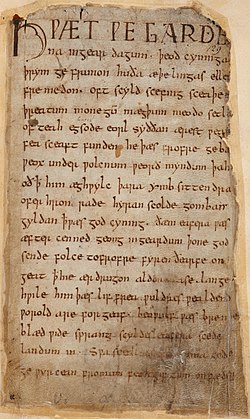


Your reading
Which translation to read
We pick the translation most faithful to the original, in sense and in form, over the newest or the easiest.
Seamus Heaney1999Our pick
A great poet's version that keeps the alliterative line and the poem's weight; close in substance, with a few Ulster words of his own.
R. M. Liuzza2000
Close, line-by-line verse with a strong four-stress beat, made for students of the Old English.
J. R. R. Tolkien2014
Tolkien's close prose translation of 1926, published with his commentary: the most exact sense, by the poem's greatest scholar.
Where it is set