Brave New World

First published AD 1932, written in English
Brave New World is a dystopian novel by English author Aldous Huxley, written in 1931, and published in 1932. Largely set in a futuristic World State, whose citizens are environmentally engineered into an intelligence-based social hierarchy, the novel anticipates huge scientific advancements in reproductive technology, sleep-learning, psychological manipulation, and classical conditioning that are combined to make a seemingly utopian society which is challenged by an outsider character, John the Savage. Huxley followed this book with a reassessment in essay form, Brave New World Revisited (1958), and with his final novel, Island (1962), the utopian counterpart. This novel is often used as a companion piece or inversion counterpart to George Orwell's Nineteen Eighty-Four (1949).
Draws on The Tempest and We.See Brave New World in its lineage


Your reading
Sign in to add this book to your map.
Where it is set
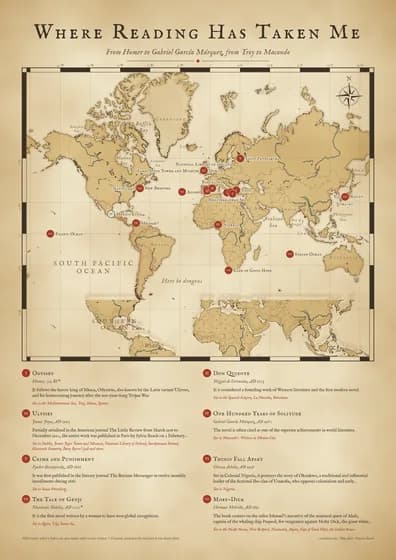 Put Brave New World on a mapAn engraved chart of every place it is set, to frame or to share. Add the other books you have read.
Where it was written
- Sanary-sur-Mer
France
Huxley wrote Brave New World while living in Sanary-sur-Mer, France, in the four months from May to August 1931. Source: Wikipedia, reviewed

What it draws on
- The Tempest
William Shakespeare, AD 1623
The title is Miranda's wonder at seeing other people for the first time: 'O brave new world, that has such people in't!' In Huxley's world state the line turns bitter in the mouth of John the Savage, who knows nothing but Shakespeare.
Source: Wikipedia, Brave New World
“The title Brave New World derives from William Shakespeare's The Tempest, Act V, Scene I, Miranda's speech” Read it there
- We
Yevgeny Zamyatin, AD 1924
Zamyatin's We imagined a glass city of numbered citizens, ruled by a Benefactor, where happiness is engineered and love is rationed. Orwell was sure Brave New World had borrowed from it; Huxley said he had never read it.
Source: Wikipedia, Brave New World
“George Orwell believed that Brave New World must have been partly derived from the 1921 novel We by Russian author Yevgeny Zamyatin.” Read it there
The author’s life


On these lists
- Le Monde's 100 Books of the Century, number 21
- The Guardian: The 100 best novels (Robert McCrum), number 57
- Modern Library 100 Best Novels, number 5
- BBC The Big Read, number 87
- Terra Lecta additions